🦜 Parrot Age Calculator
A parrot age calculator is a free online tool that converts your parrot's chronological age into equivalent human years using species-specific formulas. Because parrots are extraordinarily diverse — a budgie may live 15 years while a macaw can exceed 80 — this tool applies different conversion rates for budgies, cockatiels, African Greys, and macaws. Enter your bird's species and age to instantly see their human-year equivalent along with their current life stage from chick through senior.
Select your parrot's species and age to calculate their equivalent human years.
What is this tool?
Parrots are unlike any other pet when it comes to aging. The idea that "one bird year equals seven human years" simply does not work across a group where some species reach sexual maturity before their first birthday and others live longer than most humans. A budgerigar in your living room might celebrate a decade of life and be considered elderly, while a large macaw at the same age is barely out of childhood and may have another six decades ahead. Ornithologists and avian veterinarians have spent decades studying growth rates, metabolic markers, and longevity data across psittacine species, and the consensus is clear: each species follows its own biological clock. This calculator uses species-typical lifespan data compiled by organizations like the World Parrot Trust and major zoological institutions to build a conversion model for four of the most popular companion parrots. For budgies, the first year maps to roughly 8 human years and each subsequent year adds about 5, reflecting their fast metabolism and short lifespan. Cockatiels grow a bit more slowly: 6 human years for the first and 3 for each year after. African Greys, known for their cognitive brilliance and 40–60 year lifespan, age at roughly 4 human years initially and then just 1.2 per year. Macaws are the true elders of the parrot world — only 3 human years for the first birthday, then a mere 0.9 per year, stretching their youth across decades. The tool also calculates what percentage of the species' typical lifespan your bird has lived, then assigns a life stage: chick, juvenile, adult, or senior. This gives you a much richer picture than a single number. If you also have other companion animals, try our Dog Age Calculator or Cat Age Calculator; for tracking your own health alongside your pet's, the BMI Calculator is a handy companion.How it works
This calculator applies four species-specific conversion formulas, each tuned to the biological clock of a different parrot. For budgies (parakeets), year one equals 8 human years and each year after adds 5, with a typical maximum lifespan of 15 years. For cockatiels, year one equals 6 human years, each subsequent year adds 3, and the typical lifespan is about 25 years. African Greys get 4 human years for year one and then 1.2 per year thereafter, with a typical lifespan of 60 years. Macaws get 3 human years for year one and just 0.9 for each additional year, reflecting a lifespan that can reach 80 years or more. Once the human-year equivalent is calculated, the tool also computes the percentage of the species' typical lifespan your parrot has already lived and assigns a life stage. If that percentage is under 15%, your bird is a chick; 15–29% is a juvenile; 30–74% is an adult; and 75% or above is a senior. This dual approach — human-year equivalent plus life-stage percentage — gives you a much more meaningful picture than a flat conversion ratio.Why Does Species Matter So Much?
Parrots span an enormous range of lifespans. A budgie typically lives about 15 years, while a macaw can reach 80 or more. This means a 5-year-old budgie is already middle-aged — roughly 27 in human-equivalent years — whereas a 5-year-old macaw is barely a toddler at just 5 human-equivalent years. You simply cannot apply one formula to all parrots.
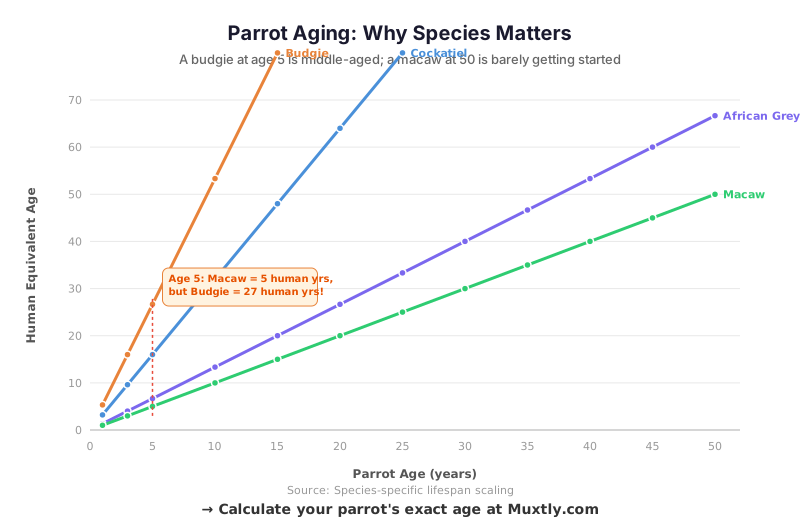
That is why knowing your parrot's species is the single most important factor in any age conversion. A number that means "halfway through life" for one species could mean "just getting started" for another.
Worked Example
Here is a step-by-step example using a 10-year-old African Grey Parrot.
For African Greys, year one = 4 human years, and each subsequent year adds 1.2. So for a 10-year-old bird: 4 + (10 − 1) × 1.2 = 4 + 10.8 = 14.8 human years (rounded to 15).
The typical lifespan for an African Grey is 60 years. So 10 ÷ 60 × 100 = 16.7% of typical lifespan (rounded to 17%).
At 17% of the typical lifespan, this African Grey falls in the Juvenile stage — past babyhood but still young, with decades of life ahead.
Reference Table
| Age (years) | Budgie | Cockatiel | African Grey | Macaw |
|---|---|---|---|---|
| 1 | 8 | 6 | 4 | 3 |
| 3 | 18 | 12 | 6.4 | 4.8 |
| 5 | 28 | 18 | 8.8 | 6.6 |
| 10 | 53 | 33 | 14.8 | 11.1 |
| 15 | 78 | 48 | 20.8 | 15.6 |
| 20 | — | 63 | 26.8 | 20.1 |
| 30 | — | — | 38.8 | 29.1 |
| 50 | — | — | 62.8 | 47.1 |
Values are species-specific human-year equivalents. "—" indicates the age exceeds the typical maximum lifespan for that species.
How to use
- Select your parrot's species from the dropdown — budgie (parakeet), cockatiel, African Grey, or macaw. Each species has its own conversion formula.
- Enter your parrot's current age in years. You can use decimals such as 0.5 for six months or 2.5 for two and a half years.
- Click the Calculate button to run the species-specific formula and determine the human-year equivalent.
- Read the primary result, which shows the equivalent human age based on your parrot's species.
- Review the life stage label and lifespan percentage to understand where your parrot stands relative to the typical lifespan for its species.
Frequently Asked Questions
Why do different parrot species need different age formulas?
Parrots are one of the most diverse groups of companion animals. A budgie might live 8–15 years while a large macaw can reach 80 or more, so applying a single conversion ratio to all species makes no sense. This tool uses separate formulas calibrated to the typical lifespan and growth rate of each species, giving you a much more accurate human-year equivalent.
How accurate is the human-year equivalent for parrots?
The formulas are based on species-typical lifespan data and growth-rate estimates compiled by avian researchers and zoological institutions. They provide a reasonable approximation for educational purposes, but individual birds vary based on genetics, diet, environment, and veterinary care. Think of the result as a helpful reference, not a precise biological measurement.
What does the lifespan percentage mean?
The lifespan percentage shows how much of the species' typical lifespan your parrot has already lived. For example, a 12-year-old cockatiel has reached about 48% of a typical 25-year lifespan. This percentage determines the life stage label — chick, juvenile, adult, or senior — and helps you understand where your bird is in its life journey.
At what age is my parrot considered a senior?
It depends entirely on the species. Because the senior threshold is 75% of the typical lifespan, a budgie is senior at around 11–12 years, a cockatiel at about 19, an African Grey at roughly 45, and a macaw at around 60. The calculator automatically labels your bird as senior when it crosses this threshold.
Can I use this calculator for other parrot species?
The tool covers the four most popular companion parrot species. If you have a conure, lovebird, Amazon, Eclectus, or another species, choose the closest match in terms of typical lifespan — for example, cockatiel settings work reasonably well for many medium-sized parrots that live 20–30 years. For the most accurate results, consult an avian veterinarian familiar with your specific species.
Tips & Advice
Treat the result as a fun and educational reference point, not a veterinary diagnosis. Parrots are individuals, and factors like diet, exercise, mental stimulation, genetics, and veterinary care all influence how quickly they age in practice. A well-cared-for African Grey may remain vibrant well into its forties, while a neglected bird of the same age could show significant decline. Keep in mind that this tool uses species-typical averages — hybrid parrots or individuals from unusually long-lived lines may not fit neatly into the model. If your bird is nearing the senior threshold, it is a good time to schedule a wellness check with an avian vet and discuss age-appropriate diet adjustments, enrichment activities, and screening for common age-related conditions. Enrichment, socialization, and a varied, species-appropriate diet remain the strongest pillars of long-term parrot health at every life stage.
Related Tools
Dog Age Calculator
Calculate your dog's age in human years with our free dog age calculator. Uses A
Cat Age Calculator
Calculate your cat's age in human years with our free cat age calculator. Based
Hamster Age Calculator
Calculate your hamster's age in human years with our free hamster age calculator
Rabbit Age Calculator
Free online rabbit age calculator. Convert your rabbit's age into human years us
BMI Calculator
Calculate your BMI with our free online BMI calculator. Enter height and weight