🐇 Rabbit Age Calculator
Enter your rabbit's age to convert it into human years and see its life stage.
What is this tool?
Understanding how old your rabbit is in human terms helps you provide better care at every stage of its life. Rabbits age much faster than humans, and their development follows a pattern similar to cats — a baby rabbit (called a kit) reaches the equivalent of a human teenager within its first year. The House Rabbit Society, one of the most respected authorities on rabbit welfare, provides a widely accepted aging reference that this calculator is based on. According to that reference, a rabbit's first year corresponds to roughly 16 human years of rapid growth, the second year adds about 6 more human years (reaching 22), and every year after that adds another 6 human years. This means a 5-year-old indoor rabbit is already in its mid-forties by human standards, and a 10-year-old rabbit is well into its senior years. Lifespan depends heavily on living environment: well-cared-for indoor rabbits commonly live 8 to 12 years, while outdoor rabbits typically live only 5 to 8 years due to predators, weather stress, and disease exposure. If you also have other pets, you might enjoy our Cat Age Calculator or Dog Age Calculator, and for tracking your own wellness milestones, try the BMI Calculator.How it works
This calculator uses the House Rabbit Society aging formula to convert rabbit years into human years. The conversion is not a simple multiplication — instead, it accounts for the fact that rabbits mature extremely quickly in their first year and then settle into a more gradual aging rate. Specifically: the first rabbit year equals 16 human years (representing rapid growth from kit to young adult), the second rabbit year adds 6 human years (cumulative total of 22), and each additional year beyond the second adds another 6 human years. The formula in code form is: if age ≤ 1, human age = age × 16; if age ≤ 2, human age = 16 + (age − 1) × 6; if age > 2, human age = 22 + (age − 2) × 6. The tool then maps the result to a life stage — Baby (Kit), Young Adult, Adult, Middle-aged, or Senior — and estimates how far along the rabbit is in its typical lifespan, adjusting for whether it lives indoors or outdoors. Why Not Just Multiply by 7?
Rabbits, like dogs and cats, do not age in a straight line. The old "1 rabbit year = 7 human years" rule assumes a constant rate, but the House Rabbit Society (HRS) method reflects how rabbits really mature: explosively at first, then gradually. Under the HRS formula, a 6-month-old rabbit is already about 8 in human years, a 1-year-old is 16, and by age 2 a rabbit has reached 22. After that, aging slows to roughly +6 human years per rabbit year. The ×7 rule therefore underestimates young rabbits (it gives a 1-year-old only 7 instead of 16) while slightly overestimating very old ones.
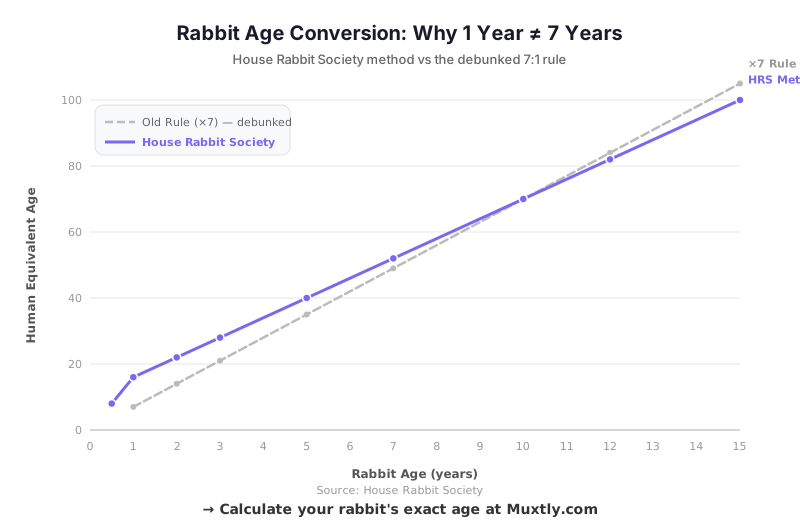
| Rabbit Age | ×7 Rule | HRS Method | Difference |
|---|---|---|---|
| 0.5 years | 3.5 | 8 | HRS 2.3× higher |
| 1 year | 7 | 16 | HRS 2.3× higher |
| 2 years | 14 | 22 | HRS 1.6× higher |
| 5 years | 35 | 40 | Close |
| 8 years | 56 | 58 | Nearly the same |
| 12 years | 84 | 82 | ×7 overestimates |
Compared with dogs and cats, the ×7 rule is actually less wildly off for rabbits—around middle age the two methods nearly agree. But it still gets the critical first year wrong by more than double, and it overshoots in old age. The HRS method gives a far more accurate picture across a rabbit's entire life.
Worked Example
Here is a step-by-step example showing how the calculator converts a 4-year-old indoor rabbit into human years.
A rabbit that is 4 years old and lives indoors. Typical indoor lifespan is 12 years.
Since age is greater than 2, use: human age = 22 + (age − 2) × 6 = 22 + (4 − 2) × 6 = 22 + 12 = 34.
A human age of 34 falls in the Adult range (22–40), so this rabbit is a mature adult in the prime of life.
The rabbit is 34 human years, life stage: Adult, and has lived roughly 33% of a typical 12-year indoor lifespan.
Rabbit Age to Human Years Reference Table
This table shows the House Rabbit Society conversion from rabbit years to human years, along with the corresponding life stage. Indoor rabbits commonly reach 8 to 12 years; outdoor rabbits typically reach 5 to 8 years.
| Rabbit Age | Human Years | Life Stage |
|---|---|---|
| 0.5 years (6 months) | 8 | Baby (Kit) |
| 1 year | 16 | Young Adult |
| 2 years | 22 | Young Adult |
| 3 years | 28 | Adult |
| 4 years | 34 | Adult |
| 5 years | 40 | Adult |
| 6 years | 46 | Middle-aged |
| 7 years | 52 | Middle-aged |
| 8 years | 58 | Senior |
| 10 years | 70 | Senior |
| 12 years | 82 | Senior |
How to use
- Enter your rabbit's current age in years. You can use decimals such as 0.5 for six months or 1.5 for eighteen months.
- Select the living environment — Indoor (typical lifespan 8 to 12 years) or Outdoor (typical lifespan 5 to 8 years). This adjusts the lifespan percentage estimate.
- Click the Calculate button to see your rabbit's age in human years, its current life stage, and roughly how far along it is in its expected lifespan.
- Use the reference table below to compare different rabbit ages and plan age-appropriate care, diet, and enrichment activities.
- Review the life stage label to see where your rabbit falls on the aging spectrum — from Baby to Senior — and use this information to adjust diet, exercise, and veterinary care accordingly.
Frequently Asked Questions
How do I calculate my rabbit's age in human years?
This calculator uses the House Rabbit Society formula: the first year equals 16 human years, the second adds 6 more (for a cumulative 22), and each additional year adds another 6. So a 3-year-old rabbit is about 28 in human years, and a 5-year-old rabbit is about 40.
What is the typical lifespan of a pet rabbit?
Indoor rabbits that receive proper care typically live 8 to 12 years, with some reaching 14 or more. Outdoor rabbits generally have shorter lifespans of 5 to 8 years due to exposure to predators, temperature extremes, and disease. Diet, genetics, and veterinary care all play major roles.
How can I tell how old my rabbit is?
If you adopted from a shelter or breeder, records are the most reliable source. Without records, a veterinarian can estimate age by checking the teeth, claws, coat condition, and overall muscle tone. Baby rabbits (under 6 months) are easy to identify by size and behavior, but after adulthood, aging becomes less precise.
Do rabbits age like cats or dogs?
Rabbit aging is most often compared to cat aging because both species reach near-adult size within their first year and then age gradually at a similar rate. Dogs, by contrast, have breed-dependent aging curves. See our Cat Age Calculator for a direct comparison.
What life stage is my rabbit in?
Rabbits under 6 months are babies (kits), 6 months to 2 years are young adults, 2 to 5 years are mature adults, 5 to 8 years are middle-aged, and rabbits over 8 years are considered seniors who may need special care and more frequent veterinary checkups.
Tips & Advice
Use this rabbit age converter to plan age-appropriate care, diet, and veterinary checkups. Young rabbits (under 2 years) need plenty of space to run and a diet focused on unlimited hay with growing portions of pellets, while senior rabbits (over 8 years) may require softer foods, more frequent vet visits, and extra warmth in winter. Keep in mind that the House Rabbit Society formula is an approximation — individual rabbits age at different rates depending on breed, genetics, diet, and environment. Large breeds tend to have slightly shorter lifespans, while small mixed-breed rabbits often live longest. Always consult a rabbit-savvy veterinarian for advice tailored to your specific pet.Related Tools
Dog Age Calculator
Calculate your dog's age in human years with our free dog age calculator. Uses A
Cat Age Calculator
Calculate your cat's age in human years with our free cat age calculator. Based
Hamster Age Calculator
Calculate your hamster's age in human years with our free hamster age calculator
BMI Calculator
Calculate your BMI with our free online BMI calculator. Enter height and weight
Free Calorie Calculator
Calculate your daily calorie needs with our free Calorie Calculator. Get BMR and