🐕 Dog Age Calculator
A dog age calculator is a free online tool that converts your dog's chronological age into equivalent human years using two established scientific methods. The AKC size-adjusted method accounts for the fact that smaller dogs live longer and age more slowly after maturity, while the UCSD 2020 epigenetic formula uses DNA methylation data to map aging at a molecular level. Enter your dog's age and weight class to instantly see both estimates along with their current life stage from puppy through geriatric.
Enter your dog's age and size to calculate their age in human years.
What is this tool?
For decades, the rule of thumb was that one dog year equals seven human years. It is a tidy piece of folk wisdom, but it falls apart the moment you look closely: a one-year-old dog is already approaching reproductive maturity, while a seven-year-old human is barely starting first grade. Veterinarians have long known that canines age far faster than the linear 7:1 ratio suggests, especially during their first two years of life. The American Kennel Club (AKC) popularized a size-adjusted model that assigns 15 human years to the first year of life, 9 to the second year, and then 4 to 7 years per subsequent year depending on breed size — because a Chihuahua and a Great Dane simply do not follow the same biological clock. In 2020, researchers at UC San Diego published a groundbreaking epigenetic study in the journal Cell that mapped how DNA methylation patterns change over time in Labrador Retrievers. They derived a precise formula — 16 × ln(age) + 31 — that aligns canine aging with human aging on a molecular level and confirmed that dogs age explosively in their early years before the curve flattens out. This tool gives you both perspectives so you can better understand your companion's stage of life. If you also have a feline friend at home, try our Cat Age Calculator; for monitoring your own wellness alongside your pet's, the BMI Calculator and Calorie Calculator are handy companions.How it works
This calculator runs two recognized methods side by side. The AKC size-adjusted method works as follows: year one counts as 15 human years, year two adds 9 more (for a total of 24), and every year after that adds 4, 5, 6, or 7 years depending on whether your dog is small (under 10 kg), medium (10–25 kg), large (25–45 kg), or giant (over 45 kg). Smaller dogs age slower and live longer, so they accumulate fewer human-year equivalents per calendar year. The UCSD 2020 epigenetic formula takes a completely different approach: it is 16 × ln(age) + 31, where ln is the natural logarithm of the dog's chronological age. This formula was derived by comparing DNA methylation markers — chemical tags on DNA that change predictably with age — between dogs and humans. The result is a smooth curve that rises steeply in the first few years and then levels off, mirroring how dogs mature rapidly and then age more gradually. The tool displays both numbers along with a life-stage label (puppy, adult, senior, or geriatric) so you get a well-rounded picture.Why Not Just Multiply by 7?
The old "1 dog year = 7 human years" rule assumes dogs age at a constant rate. They don’t. Dogs mature explosively in their first two years and then the curve flattens. That’s why the AKC method gives 15 human years for year one (not 7), then only 9 for year two, then 4–7 per year after that.
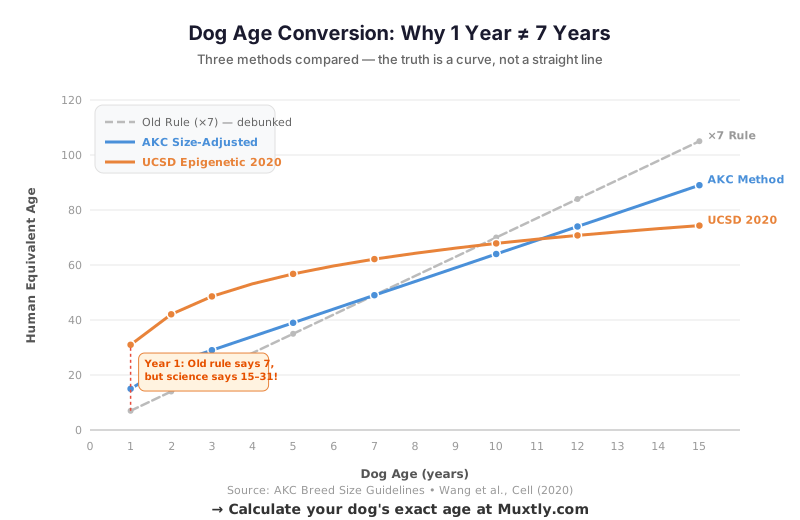
| Dog Age | Old Rule (×7) | AKC (Medium) | UCSD Epigenetic |
|---|---|---|---|
| 1 yr | 7 | 15 | 31 |
| 2 yrs | 14 | 24 | 42 |
| 5 yrs | 35 | 39 | 57 |
| 10 yrs | 70 | 64 | 68 |
All three methods agree on one thing: the 7:1 rule dramatically underestimates aging in the first two years and overestimates it later. The truth is a curve, not a straight line.
Worked Example
Here is a step-by-step example using a 5-year-old medium-sized dog weighing about 18 kg.
Year 1 = 15 human years. Year 2 = +9, for a total of 24. Years 3, 4, and 5 each add 5 years (medium dog rate). So 24 + (5 − 2) × 5 = 24 + 15 = 39 human years.
16 × ln(5) + 31. The natural log of 5 is approximately 1.609. So 16 × 1.609 + 31 = 25.7 + 31 = 56.8 human years.
With an AKC equivalent of 39, this dog is in the Adult stage — solidly in the middle of life, not yet approaching senior years.
Reference Table
| Dog Age (years) | Small | Medium | Large | Giant |
|---|---|---|---|---|
| 1 | 15 | 15 | 15 | 15 |
| 2 | 24 | 24 | 24 | 24 |
| 3 | 28 | 29 | 30 | 31 |
| 5 | 36 | 39 | 42 | 45 |
| 7 | 44 | 49 | 54 | 59 |
| 10 | 56 | 64 | 72 | 80 |
| 12 | 64 | 74 | 84 | 94 |
| 15 | 76 | 89 | 102 | 115 |
Values are AKC size-adjusted human-year equivalents. The epigenetic formula (16 × ln(age) + 31) applies the same regardless of size.
How to use
- Choose your dog's size category — small (under 10 kg), medium (10–25 kg), large (25–45 kg), or giant (over 45 kg). Base this on their typical adult weight.
- Enter your dog's current age in years. You can use decimals such as 0.5 for six months or 1.5 for eighteen months.
- Click the Calculate button to run both the AKC size-adjusted method and the UCSD 2020 epigenetic formula.
- Read the primary result, which shows the AKC equivalent human years based on your dog's size.
- Review the epigenetic estimate and the life-stage label to get a fuller picture of where your dog stands on the aging curve.
Frequently Asked Questions
Why does size matter when calculating dog age?
Smaller dogs mature at a similar rate to large dogs early on, but after the first two years they age more slowly and live considerably longer. A Great Dane is considered senior at six, while a Chihuahua may not reach senior status until ten or eleven. The AKC size-adjusted method accounts for this by applying different per-year rates after age two.
What is the UCSD 2020 epigenetic formula?
In 2020, researchers at UC San Diego studied how DNA methylation — a chemical modification to DNA that changes with age — progresses in dogs compared to humans. They derived the formula 16 × ln(age) + 31, which maps a dog's chronological age to an equivalent human age based on molecular markers rather than guesswork. It is considered one of the most scientifically grounded approaches to date.
How accurate is the old 7:1 rule?
The idea that one dog year equals seven human years is a rough oversimplification that has been largely debunked. It would make a one-year-old dog equivalent to a seven-year-old child, which is clearly wrong since most dogs are sexually mature by age one. Modern methods like the AKC size-adjusted model and the epigenetic formula are far more accurate.
Which method should I trust more?
Both have strengths. The AKC method is practical and widely used by veterinarians because it accounts for breed size, which is the single biggest factor in canine aging. The epigenetic formula is more precise on a biological level but was calibrated using Labrador Retrievers, so it may be slightly less accurate for very small or very large breeds.
At what age is my dog considered a senior?
It depends on size. Small dogs typically enter their senior years around age 10 to 12, medium dogs around 8 to 10, large dogs around 6 to 8, and giant breeds as early as 5 to 6. This calculator labels dogs as senior below 75 equivalent human years and geriatric at 75 and above.
Tips & Advice
Use the result as a conversation starter with your vet, not a substitute for professional advice. The AKC method is excellent for understanding how size affects aging, while the epigenetic formula is most reliable for dogs over one year old. Keep in mind that mixed-breed dogs can be harder to classify by size — when in doubt, pick the category that matches their adult weight. If your dog falls near a boundary between life stages, focus on behavior and health markers rather than the number alone: energy levels, mobility, appetite, and cognition all tell you more about real biological age than any formula. Regular checkups, age-appropriate nutrition, and mental stimulation are the best ways to support a long, healthy life at any stage.
Related Tools
Cat Age Calculator
Calculate your cat's age in human years with our free cat age calculator. Based
BMI Calculator
Calculate your BMI with our free online BMI calculator. Enter height and weight
Free Calorie Calculator
Calculate your daily calorie needs with our free Calorie Calculator. Get BMR and
Baby Growth Percentile Calculator
Check your baby’s growth percentile on WHO charts. Enter age, gender, weight, le
Healthy Weight Calculator
Find your healthy weight range based on height and frame size. See your BMI-base