🐈 Cat Age Calculator
A cat age calculator is a free online tool that converts your cat's chronological age into equivalent human years using the AAFP 2021 feline life stage guidelines. The method accounts for the fact that cats mature rapidly in their first two years and then settle into a steadier aging rate that differs depending on whether they live indoors or go outside. Enter your cat's age and lifestyle to instantly see their human-year equivalent along with their current life stage from kitten through super senior.
Enter your cat's age and lifestyle to calculate their age in human years.
What is this tool?
The old myth that one cat year equals seven human years has been thoroughly debunked by feline veterinarians. Cats mature far faster than that in their early years — a one-year-old cat is already a young adult, roughly equivalent to a 15-year-old human, and by age two they have reached full physical maturity at about 24 human years. The American Association of Feline Practitioners (AAFP) developed a science-based framework that divides a cat's life into five distinct stages: kitten (0–1), young adult (1–6), mature adult (7–10), senior (11–14), and super senior (15+). Each stage comes with its own health considerations, from vaccination schedules in kittenhood to kidney monitoring in the senior years. The calculator also factors in lifestyle, because indoor cats typically live longer and age more slowly than outdoor cats, who face greater risks from traffic, predators, disease, and environmental stress. After the first two years, indoor cats accumulate about 4 human years per calendar year, while outdoor cats age at roughly 6 human years per year. If you also have a canine companion at home, try our Dog Age Calculator; for tracking your own wellness alongside your pet's, the BMI Calculator and Calorie Calculator are handy companions.How it works
This calculator follows the AAFP 2021 feline life stage guidelines. The logic is straightforward: year one counts as 15 human years, reflecting the explosive growth and maturation that happens between birth and sexual maturity. Year two adds 9 more, for a cumulative total of 24 human years — by this point a cat is fully grown and physiologically comparable to a young adult human. From year three onward, the aging rate depends on lifestyle: indoor cats add 4 human years per calendar year, while outdoor or indoor-outdoor cats add 6. This difference exists because outdoor cats face cumulative risks — infectious disease, parasites, territorial conflicts, traffic exposure, and environmental stressors — that effectively accelerate biological aging. The tool rounds the final number and assigns a life-stage label based on the human-year equivalent: under 15 is Kitten, 15–36 is Young Adult, 37–56 is Mature Adult, 57–72 is Senior, and 73 and above is Super Senior.Why Not Just Multiply by 7?
The old "1 cat year = 7 human years" rule assumes cats age at a constant, linear rate. They don't. Cats mature explosively in their first two years — year one alone equals 15 human years, and by the end of year two a cat has already reached 24 human years (the equivalent of a full-grown young adult). Only after that does the curve flatten, to roughly +4 human years per calendar year for indoor cats and +6 for outdoor cats. The ×7 rule massively underestimates early aging: it says a one-year-old cat is 7 when it's really 15.
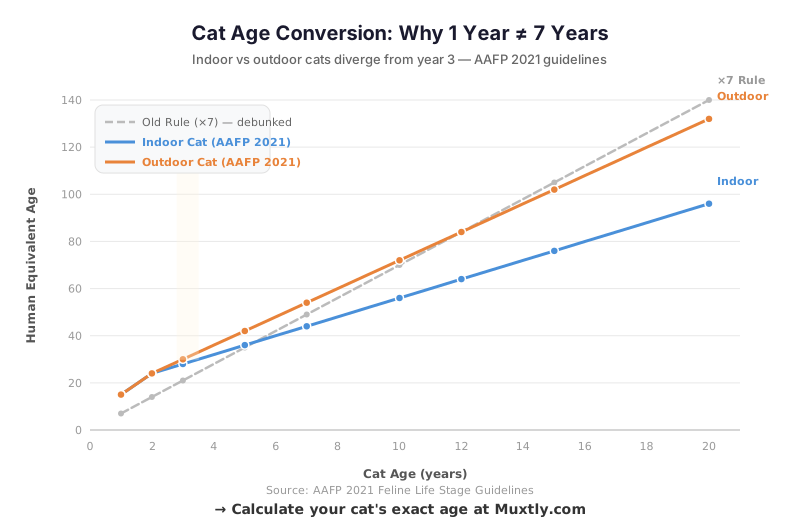
The truth is a curve, not a straight line.
Worked Example
Here is a step-by-step example using a 5-year-old indoor cat.
Year 1 = 15 human years. Year 2 = +9, for a total of 24. Years 3, 4, and 5 each add 4 years (indoor rate). So 24 + (5 − 2) × 4 = 24 + 12 = 36 human years.
With a human-year equivalent of 36, this cat is at the upper end of the Young Adult stage — about to transition into the Mature Adult phase.
If the same cat lived outdoors, the calculation would be 24 + (5 − 2) × 6 = 24 + 18 = 42 human years — six extra years of biological aging.
Reference Table
| Cat Age (years) | Indoor | Outdoor |
|---|---|---|
| 1 | 15 | 15 |
| 2 | 24 | 24 |
| 3 | 28 | 30 |
| 5 | 36 | 42 |
| 7 | 44 | 54 |
| 10 | 56 | 72 |
| 12 | 64 | 84 |
| 15 | 76 | 102 |
| 20 | 96 | 132 |
Values are human-year equivalents based on AAFP 2021 feline life stage guidelines. Years 1 and 2 are identical for both lifestyles; the rate diverges from year 3 onward.
How to use
- Select your cat's lifestyle — indoor cat or outdoor / indoor-outdoor. This determines the aging rate after the first two years.
- Enter your cat's current age in years. You can use decimals such as 0.5 for six months or 1.5 for eighteen months.
- Click the Calculate button to run the AAFP 2021 feline life stage conversion.
- Read the primary result, which shows the equivalent human years based on your cat's age and lifestyle.
- Review the life-stage label to understand where your cat falls on the feline aging spectrum, from kitten to super senior.
Frequently Asked Questions
Why do indoor and outdoor cats age at different rates?
Outdoor cats face ongoing environmental risks including infectious diseases, parasites, predators, traffic, and territorial fights. These cumulative stressors effectively accelerate biological aging. The AAFP guidelines reflect this by applying a faster aging rate — 6 human years per calendar year versus 4 for indoor cats — after the first two years of life.
Is the old 7:1 rule accurate for cats?
No. The idea that one cat year equals seven human years is a myth that dramatically underestimates feline aging in the early years. A one-year-old cat is already equivalent to a 15-year-old human, not a 7-year-old child. The AAFP method, which assigns 15 years to the first year and 9 to the second, is far more accurate.
What is the AAFP 2021 feline life stage guideline?
The American Association of Feline Practitioners published updated guidelines in 2021 that divide a cat's life into five stages: kitten (0–1 year), young adult (1–6), mature adult (7–10), senior (11–14), and super senior (15+). Each stage has specific health monitoring recommendations, making it easier for veterinarians and owners to provide age-appropriate care.
At what age is my cat considered a senior?
Under the AAFP guidelines, cats enter the senior stage at age 11, which corresponds to roughly 57 human years. Before that, the mature adult stage spans ages 7 to 10. Cats 15 years and older are classified as super senior, equivalent to a human in their mid-seventies or beyond.
How long do indoor cats typically live?
Indoor cats generally live 12 to 20 years, with many reaching their early twenties. The protected environment eliminates most causes of premature death that affect outdoor cats. Regular veterinary care, a balanced diet, and mental stimulation can help your indoor cat live a long, healthy life well into the super senior stage.
Tips & Advice
Use the result to start conversations with your veterinarian about age-appropriate care, not as a substitute for professional advice. The lifestyle setting matters more than most people realize: indoor cats regularly live into their late teens and even twenties, while outdoor cats have an average lifespan of just 2 to 5 years due to environmental hazards. If your cat is a strictly indoor cat with occasional supervised outdoor time, the indoor setting is the better choice. For senior and super senior cats, schedule veterinary checkups at least twice a year, as age-related conditions like kidney disease, hyperthyroidism, and diabetes can develop quickly. Nutrition, dental care, and environmental enrichment — climbing spaces, puzzle feeders, interactive play — all contribute to a longer, healthier life at every stage.
Related Tools
Dog Age Calculator
Calculate your dog's age in human years with our free dog age calculator. Uses A
Hamster Age Calculator
Calculate your hamster's age in human years with our free hamster age calculator
Rabbit Age Calculator
Free online rabbit age calculator. Convert your rabbit's age into human years us
BMI Calculator
Calculate your BMI with our free online BMI calculator. Enter height and weight
Free Calorie Calculator
Calculate your daily calorie needs with our free Calorie Calculator. Get BMR and